Daphne ChenI am a PhD student at the Paul G. Allen School at the University of Washington in the Human-Centered Robotics Lab. Currently, I am also a Research Intern at Microsoft Research (MSR) in the Physically Embodied AI and Robotics group, working on human-in-the-loop robot learning. I received my Masters of Science in Robotics from the Robotics Institute at Carnegie Mellon University. Previously, I graduated from Georgia Tech, where I got my start in robotics research at the RAIL Lab. Email / GitHub / Google Scholar / Twitter |
|
Updates
|
ResearchI'm interested in machine learning, robotics, and human-centered AI. |
A Few Words Go a Long Way: Language Guided Robot Policy SynthesisDaphne Chen, Archit Ritesh Jain, Eric Goossen, Emma Romig, Michael Murray, Nick Walker, Maya Cakmak Under Review, 2026 code / website / We present ARCHITECT, an agentic orchestration framework that synthesizes robot manipulation policies from natural language instructions and corrections, building a persistent skill library that transfers across tasks. |
|
FlowDAgger: Human-in-the-Loop Adaptation of Generative Robot Policies in Latent SpaceMichael Murray, Daphne Chen, Simran Bagaria, Dean Fortier, Tess Hellebrekers, Galen Mullins, Harshavardhan Gajarla, Oier Mees, Maya Cakmak, Andrey Kolobov arXiv, 2026 arxiv / code / website / We present FlowDAgger, a sample- and compute-efficient method for adapting frozen generative robot policies from human interventions in latent space. |
|
Improving Human-AI Coordination through Adversarial Training and Generative ModelsParesh Chaudhary, Yancheng Liang, Daphne Chen, Simon S. Du, Natasha Jaques ICLR, 2026 arxiv / code / website / We use generative models in an online adversarial training loop to train the learning agent against difficult coordination scenarios while maintaining realistic behavior. |
|
Learning to Cooperate with Humans using Generative AgentsYancheng Liang, Daphne Chen, Abhishek Gupta, Simon S. Du, Natasha Jaques NeurIPS, 2024 arxiv / code / website / We use generative models to sample infinite human-like partner agents to train a coordinator agent. These agents cooperate well with real human players, achieving better performance compared to baselines FCP, CoMeDi and MEP. |
|
DROID: A Large-Scale In-the-Wild Robot Manipulation DatasetAlexander Khazatsky*, Karl Pertsch*, ..., Daphne Chen, ... Robotics: Science and Systems (RSS), 2024 arxiv / website / A large-scale, in-the-wild robot manipulation dataset spanning diverse scenes, tasks, and environments to support generalizable robot learning. |
|
Open X-Embodiment: Robotic Learning Datasets and RT-X ModelsAbby O'Neill, Abdul Rehman, ..., Daphne Chen, ... ICRA (Best Paper Award), 2024 arxiv / website / A collaborative effort standardizing robot learning datasets across many institutions and embodiments, and training generalist RT-X policies that transfer across robots. |
|
|
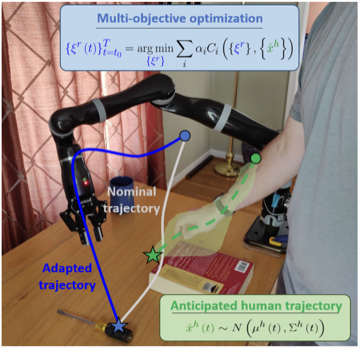
Anticipatory Human-Robot Collaboration via Multi-Objective Trajectory OptimizationAbhinav Jain, Daphne Chen, Dhruva Bansal, Sam Scheele, Mayank Kishore, Hritik Sapra, David Kent, Harish Ravichandar, Sonia Chernova IROS, 2020 arxiv / We address the problem of adapting robot trajectories to improve safety, comfort, and efficiency in human-robot collaborative tasks. To this end, we propose CoMOTO, a trajectory optimization framework that utilizes stochastic motion prediction to anticipate the human’s motion and adapt the robot’s joint trajectory accordingly. |
|
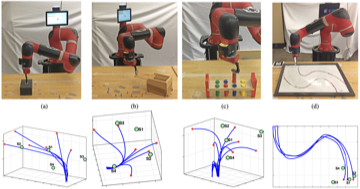
Benchmark for Skill Learning from Demonstration: Impact of User Experience, Task Complexity, and Start Configuration on PerformanceM. Asif Rana, Daphne Chen, Jacob Williams, Vivian Chu, S. Reza Ahmadzadeh, Sonia Chernova ICRA, 2020 arxiv / website / We contribute a study benchmarking the performance of multiple motion-based learning from demonstration approaches. |
|
Design and source code from Jon Barron's website |